Popular Posts

Showing posts with label ydna. Show all posts

Thursday, April 7, 2011

X-Factor has us wondering Y


'P' FOR PRISCILLA MITOCHONDRIAL DNA CLASS DISCOVERED

[Yahoo! April 7, 2011]

Scientists say that they have uncovered the first known gay 'caveman' 5000 years after his death.

Archeologists have uncovered the grave of a man they believed to have died between 2900 and 2500 B.C. and was seemingly buried in a way that suggests he was homosexual.

The skeleton of the man, found during an excavation in the Czech Republic, was found on his left side with his head facing west, buried with household jugs and no weapons.

An oval-shaped jug was also found near the feet of the skeleton.

During that period, men were traditionally buried with weapons, hammers and flint knives, and their bodies were placed on their right side with the head facing east.

Women were interred with their bodies on the left, head facing west, and buried with necklaces made from teeth, pets, and copper earrings, as well as domestic jugs and an egg-shaped pot placed near the feet.

Scientists are certain that the body placement was not a mistake, as customs were very strict on burial and funerals at the time.

"From history and ethnology, we know that people from this period took funeral rites very seriously so it is highly unlikely that this positioning was a mistake," said lead researcher Kamila Remisova Vesinova.

"Far more likely is that he was a man with a different sexual orientation, homosexual or transvestite. What we see here does not add up to traditional Corded Ware cultural norms."

There had been previous skeletons discovered where a female warrior had been buried like a man, and Siberian shamans, or witch doctors, had been buried in a similar way to the "gay" caveman, another member of the archaeological team, Katerina Semradova, said.

"This later discovery was neither of those. We believe this is one of the earliest cases of what could be described as a transvestite or third-gender grave in the Czech Republic."

Tuesday, March 29, 2011

Were the Hyksos Western Europeans?


My previous post, about the possible linkage of the YDNA profiles of the Egyptian Pharaohs of the 18th Dynasty to modern Western Europeans, raises an interesting question:

‘Is it totally off the map that there could indeed be a logical explanation – reflecting incursions by proto-Celtic / proto-Teutonic invaders into the Eastern Mediterranean?’

The willingness of many to even consider this hypothesis is a casualty of the general preoccupation of historians with states and boundaries at the expense of a complementary consideration of processes and movements.

Let’s start by arguing that the bounded and exclusive Roman Empire and the accompanying Pax Romana were aberrations - and by noting that this aberrant period was bracketed by aggressive folk wanderings from northern tribes that directly threatened Roman power.

Indeed Rome itself was attacked in 387BC by Gallic tribes from the Danube, and eventually sacked in 410AD by the Visigoths who originated in the Ukraine.


Clearly, many of these migrations had significant push factors like crop failures consequent on abnormal climatic conditions, natural disasters (like earthquakes, floods and tsunamis), overpopulation, and the domino effects stemming from attacks on and the displacement of neighboring tribes.

But there were also the lures of plunder, easy living and glory.

So, setting the Roman Empire aside as a block to what was really a recurrent process of wandering tribal banditry, could invaders from the North have penetrated as far as Egypt?

Well, we have the example of the Vandals who crossed into Africa in 429AD and took control of the Maghreb. They were quite capable of fitting out and operating a fleet to undertake the shift from Spain to North Africa and back-up their conquest of coastal towns.

All that was needed for these kinds of long journey collective pillaging expeditions was a strong tribal political organization and an open pathway, gained through violence, to the granaries and livestock sources of the villages, towns and cities that they looted. Once agriculture had become established, the road was clear.

Clearly though, this strategy was not for the squeamish – the available food resources could not feed both the inhabitants and the intruders – massacre and dispossession were part of the game.

It must have been quite a gamble having to feed a population that was constantly on the move and one can postulate that the possibility of continued success would be a function of the richness of the country ahead, the strength of the opposition, the distances at which foragers could range effectively, and the size of the horde.

Apparently Procopius asserted that the Vandals and Alans numbered 80,000 when they moved to North Africa, which implies fielding an army of around 15,000 – 20,000.

So could the YDNA of grandfather Amenhotep III, father Akenhaten and son Tutankhamen actually have originated in Western Europe?

Well, one can spin a plausible tale that the royal family descended from intruding hordes from the Atlantic Fringe. And we know that there were intruders like the chariot-riding Hyksos who appropriated the Nile Delta around 1700BC and then went on to conquer most of Egypt until they were eventually ‘driven out’ 150 years later.

We also know that politics being politics, the conquerors of a settled state often engage in dynastic marriages. It is perfectly possible then that the rulers of the 18th Dynasty preserved the YDNA of some of the former enemies of the Egyptian population at large – much like the later Ptolemies would have preserved the Greek YDNA of their forefathers.

So could the Hyksos have been proto-Celtic / proto-Teutonic? Surely we have to say ‘Yes, maybe’.

As the maps show, there are plenty of examples from the Dark Ages Volkswanderung of ‘long journeys’, as well as the more isolated example of the Cimbri who marauded south from the Jutland Peninsula and severely threatened Roman hegemony in the period 105-101BC.


As I’ve said, the main requirement was a strong political organization grounded on terror.

Strabo describes the system nicely in his remarks about the Cimbri (shame though that as a ‘Gradualist’ Geographer, he gave little credence to rumors of catastrophes like tsunamis):

‘Their wives, who would accompany them on their expeditions, were attended by priestesses who were seers; these were grey-haired, clad in white, with flaxen cloaks fastened on with clasps, girt with girdles of bronze, and bare-footed; now sword in hand these priestesses would meet with the prisoners of war throughout the camp, and having first crowned them with wreaths would lead them to a brazen vessel of about twenty amphorae.

And they had a raised platform which the priestess would mount, and then, bending over the kettle, would cut the throat of each prisoner after he had been lifted up; and from the blood that poured forth into the vessel some of the priestesses would draw a prophecy, while still others would split open the body and from an inspection of the entrails would utter a prophecy of victory for their own people; and during the battles they would beat on the hides that were stretched over the wicker-bodies of the wagons and in this way produce an unearthly noise.

As for the Cimbri, some things that are told about them are incorrect and others are extremely improbable. For instance, one could not accept such a reason for their having become a wandering and piratical folk as this that while they were dwelling on a Peninsula they were driven out of their habitations by a great flood-tide; for in fact they still hold the country which they held in earlier times; and they sent as a present to Augustus the most sacred kettle in their country, with a plea for his friendship and for an amnesty of their earlier offence.

And when their petition was granted they set sail for home; and it is ridiculous to suppose that they departed from their homes because they were incensed on account of a phenomenon that is natural and eternal, occurring twice every day. And the assertion that an excessive flood-tide once occurred looks like a fabrication, for when the ocean is affected in this way it is subject to increases and diminutions, but these are regulated and periodical.’


Well, it’s no skin of my gums whether or not I and many of my fellow Western Europeans are related more or less directly to a sickly inbred Egyptian boy king from 3,300 years ago – but it is an interesting conjecture!

But (and this will really get some people going) the theory could also be cited to explain the origins of the 10% of Ashkenazi Jews who test R1b - whose 'feet in ancient times walked upon Western Europe's green and pleasant land' - as there have long been conjectural links between the expulsion of the Hyksos from Egypt and the Exodus led by (Tut)Moses.

Tuesday, March 1, 2011

Oetzi - Face Look and Facebook


ANOTHER FAMILY PHOTO – AND NOW A FACEBOOK PAGE OF HIS OWN

If you are involved in Family History research it is always particularly exciting to find photos and paintings related to your ancestors. I have to admit rather sadly that photos of my two maternal line great grandfathers are the oldest in my collection. Doing without an ancestral mansion is no problem but I still miss the stairway portraits.

It is gratifying then that my mitichondrial dna has provided a venerable and well-illustrated distant cousin. Not only does this relationship predate history, the relative himself is becoming more famous by the year. So much so that he has recently had a new life-size statue created in his honour – and a Facebook page has been opened on his behalf.

I’ll let the South Tyrol Museum of Archaeology Press Office take over here:

'To mark the 20th anniversary of his discovery, the South Tyrol Museum of Archaeology in Bozen is mounting a Special Exhibition to Ötzi, the Iceman, from 1 March 2011 to 15 January 2012. The Museum will also be presenting the new reconstruction of Ötzi at the opening of the exhibition.

On 19 September 2011 the Iceman celebrates 20 years of his second life. People all over the world watched on in amazement two decades ago as the intact body of a man from the Copper Age, along with his clothing and equipment, was recovered from a glacier in the Ötztal Alps where it had been preserved for 5,300 years.

Long after his death, Ötzi, Iceman, now holds humans in his spell with ever more insights into his life and death. Over three million people have so far visited Ötzi in the museum, while numerous scientists have examined him. The South Tyrol Museum of Archaeology in Bozen is thus this year dedicating the special exhibition “Ötzi20 - Life. Science. Fiction. Reality” to Ötzi.

The special exhibition occupies 1,200 m², the entire exhibition area of the museum building: four floors, each devoted to one of the topics life, science, fiction and reality, will illuminate the full range of his discovery, the circumstances of his life, the results of the research and the media reality and fictions that have grown up around him. Interactive stations as well as films, interviews and hands-on displays guarantee an educational experience that is both exciting and entertaining.

The exhibition for the first time intends to analyse Ötzi above and beyond this scientific aspect. What image of him has developed? What role do the media play in this? What phenomena have arisen around Ötzi and what unusual results has all this produced? The answers to these questions allow visitors gradually to get closer to him.

New scientific discoveries and discussions will also be contributed to the Ötzi20 exhibition throughout the year. What secrets will the latest research methods reveal? Ötzi20 is not just a retrospective, it is also a snapshot that asks questions about the future.

As a window into our archaeological past and as a social sensation, the Iceman will provide us with food for thought for a long time to come.

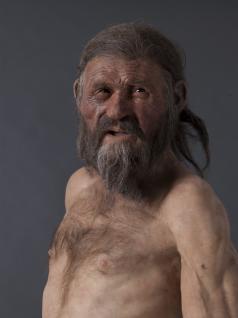
One of the most frequently asked questions today remains: what did Ötzi look like? For the opening of the exhibition the South Tyrol Museum of Archaeology will be presenting to the public a new reconstruction of Ötzi, based on anatomical 3D images of his skull.

The Museum commissioned the Dutch brothers Adrie and Alfons Kennis to create a new, naturalistic reconstruction based on scientific principles. His watchful gaze today meets visitors to the Museum, shaping our conceptions of the Stone Age inhabitants of the Alpine regions.

Ötzi gives our history a “face” in the truest sense of the word, moving and fascinating people from all over the world (see photo above).

The German photographer Heike Engel (21Lux) documented the work of the Kennis brothers over half a year and recorded the entire reconstruction process for the South Tyrolean Museum of Archaeology. Her close co-operation with the twins, revealed in a series of photos, makes their masterful handiwork seem almost close enough to touch. Her photos give viewers the feeling of actually being present in the artists’ studio.

Since his discovery, numerous artists have addressed the subject of Ötzi in the most different disciplines and techniques. One representative is the British artist, Marilène Oliver, whose installation in the special exhibition plays with the multifaceted nature of the mummy.

In her work “Iceman Frozen, Scanned and Plotted”, Oliver translated a CT scan of the body into plot points, then drilled them layer for layer into acrylic sheets and fused them together into a block.

The South Tyrolean photographic artist Brigitte Niedermair has searched all over Europe for the “Image of Ötzi” that exhibitions have created of him. Her “Tableau Vivant” of large-scale photos records numerous reconstructions of Ötzi in very different contexts and interpretations. There will be an Artist Talk with both artists in the Museion at 7.30 p.m. on 1 March, the first day that the special exhibition is open to visitors.

The Museion, Bozen’s museum for modern and contemporary art, will for the duration of the entire special exhibition be showing the work by Hans Winkler entitled “Ötzis Flucht” (Ötzi’s flight), an archaeological crime thriller featuring Ötzi’s (fictitious) tracks.

The anniversary year will also feature numerous visitor events. Ötzi20 is not simply an exhibition: alongside the “17.31 Blick.Punkte” events with the main players (curators, planners, scientists, technicians) and workshops on various topics, there are also various initiatives aimed at the 60-plus generation.

The Museum will also be offering guided tours for residents who are interested in other languages or have moved to the city from elsewhere, in languages such as Bosnian-Serbo-Croatian, Urdu, Hindi, Russian, Ukrainian and Spanish. And on 18 September and into the early morning hours of 19 September – the day that the man from the ice was discovered – there will be a major birthday celebration for Ötzi.

For current information on the events surrounding Ötzi20, the special exhibition at the South Tyrolean Museum of Archaeology, go to http://oetzi20.it.'

Thursday, October 21, 2010

West Won by Milk-thirsty Warriors


TALLER AND MORE VIOLENT MILK-DRINKING WESTERNERS FROM EAST NOT SOUTH

Having resorted to male-line ydna research to pin down my paternal great grandparents (and eventually confirm an unsuspected surname change from Shorrocks to Johnson), I was well placed to muse about the prehistoric origins of my family.

And so I bought copies of two rather bad books by Oxford academics: ‘Blood of the Isles’ by Bryan Sykes and ‘Origins of the British’ by Stephen Oppenheimer, and went on to commission the ‘Oppenheimer Test’ from EthnoAncestry.

I rather liked the result in one respect – it appeared that my ancient ancestor had originated in Catalonia and this gave me an affinity with Barcelona. On the other hand, as my ydna is very basically Northern English, I found it hard to credit that anyone in their right mind would trek from the Mediterranean coast to settle in the Pennines.

My doubts it appears were sound.

But first, let Sykes and Oppenheimer have their say:

‘Blood of the Isles’:

“The strongest (ydna) signal is a Celtic one, in the form of the clan of Oisin (R1b), which dominates the scene all over the Isles. The predominance in every part of the Isles of the Atlantis chromosome (the most frequent in the Oisin clan), with its strong affinities to Iberia, along with other matches and the evidence from the maternal side convinces me that it is from this direction that we must look for the origin of Oisin and the great majority of our Y-chromosomes…

I can find no evidence at all of a large-scale arrival from the heartland of the Celts of central Europe amongst the paternic genetic ancestry of the Isles.”

“The Celts of Ireland and the Western Isles are not, as far as I can see from the genetic evidence, related to the Celts who spread south and east to Italy, Greece and Turkey from the heartlands of Hallstadt and La Tene...during the first millennium BC…

The genetic evidence shows that a large proportion of Irish Celts, on both the male and female side, did arrive from Iberia at or about the same time as farming reached the Isles. (…)

The connection to Spain is also there in the myth of Brutus…. This too may be the faint echo of the same origin myth as the Milesian Irish and the connection to Iberia is almost as strong in the British regions as it is in Ireland. (…)”

‘Origins of the British’:

"By far the majority of male gene types in the British Isles derive from Iberia (Spain and Portugal), ranging from a low of 59% in Fakenham, Norfolk to highs of 96% in Llangefni, north Wales and 93% Castlerea, Ireland. On average only 30% of gene types in England derive from north-west Europe. Even without dating the earlier waves of north-west European immigration, this invalidates the Anglo-Saxon wipeout theory..."

"...75-95% of British Isles (genetic) matches derive from Iberia... Ireland, coastal Wales, and central and west-coast Scotland are almost entirely made up from Iberian founders, while the rest of the non-English parts of the British Isles have similarly high rates. England has rather lower rates of Iberian types with marked heterogeneity, but no English sample has less than 58% of Iberian samples..."

This it has turned out is probably a load of old cobblers.

The latest thinking is summarized below in an extensive recent article from Der Spiegel.

So I descend it seems, like many fellow Western Europeans from milk-thirsty and blood thirsty easterners who invaded the Occident in successive waves, and who were, as the Vikings believed, licked into life by a cow at the dawn of history.

The only problem with all this is that it leaves the Basques as an even more enigmatic group – plenty of cultivator and milk-drinking genes but speaking a totally non-IndoEuropean language [see lower map for the current prevalence of R1b male-line ydna].

[See also my post of Monday, February 1, 2010 'Farmers on the Frontier at cross purposes with Atlantic Fringe Hunters']

HOW MIDDLE EASTERN MILK DRINKERS CONQUERED EUROPE

[by Matthias Schulz, Der Spiegel]

New research has revealed that agriculture came to Europe amid a wave of immigration from the Middle East during the Neolithic period. The newcomers won out over the locals because of their sophisticated culture, mastery of agriculture -- and their miracle food, milk.

Wedged in between dump trucks and excavators, archeologist Birgit Srock is drawing the outline of a 7,200-year-old posthole. A concrete mixing plant is visible on the horizon. She is here because, during the construction of a high-speed rail line between the German cities of Nuremberg and Berlin, workers happened upon a large Neolithic settlement in the Upper Franconia region of northern Bavaria.

The remains of more than 40 houses were unearthed, as well as skeletons, a spinning wheel, bulbous clay vessels, cows' teeth and broken sieves for cheese production -- a typical settlement of the so-called Linear Pottery culture (named after the patterns on their pottery).

This ancient culture provided us with the blessing of bread baking. At around 5300 BC, everyone in Central Europe was suddenly farming and raising livestock. The members of the Linear Pottery culture kept cows in wooden pens, used rubbing stones and harvested grain. Within less than 300 years, the sedentary lifestyle had spread to the Paris basin.

The reasons behind the rapid shift have long been a mystery. Was it an idea that spread through Central Europe at the time, or an entire people?

Peaceful Cooperation or Invasion?

Many academics felt that the latter was inconceivable. Agriculture was invented in the Middle East, but many researchers found it hard to believe that people from that part of the world would have embarked on an endless march across the Bosporus and into the north.

Jens Lüning, a German archaeologist who specializes in the prehistoric period, was influential in establishing the conventional wisdom on the developments, namely that a small group of immigrants inducted the established inhabitants of Central Europe into sowing and milking with "missionary zeal." The new knowledge was then quickly passed on to others. This process continued at a swift pace, in a spirit of "peaceful cooperation," according to Lüning.

But now doubts are being raised on that explanation. New excavations in Turkey, as well as genetic analyses of domestic animals and Stone Age skeletons, paint a completely different picture:

 At around 7000 BC, a mass migration of farmers began from the Middle East to Europe.
 These ancient farmers brought along domesticated cattle and pigs.
 There was no interbreeding between the intruders and the original population.

Mutated for Milk

The new settlers also had something of a miracle food at their disposal. They produced fresh milk, which, as a result of a genetic mutation, they were soon able to drink in large quantities. The result was that the population of farmers grew and grew.

These striking insights come from biologists and chemists. In a barrage of articles in professional journals like Nature and BMC Evolutionary Biology, they have turned many of the prevailing views upside down over the course of the last three years.

The most important group is working on the "Leche" project (the name is inspired by the Spanish word for milk), an association of 13 research institutes in seven European Union countries. The goal of the project is to genetically probe the beginnings of butter, milk and cheese.

An unusual circumstance has made this research possible in the first place. Homo sapiens was originally unable to digest raw milk. Generally, the human body only produces an enzyme that can break down lactose in the small intestine during the first few years of life. Indeed, most adults in Asia and Africa react to cow's milk with nausea, flatulence and diarrhea.

But the situation is different in Europe, where many people carry a minute modification of chromosome 2 that enables them to digest lactose throughout their life without experiencing intestinal problems. The percentage of people with this modification is the highest among Britons and Scandinavians (see graphic).

It has long been known that these differences are based on Europeans' primeval origins. But where did the first milk drinker live? Which early man was the first to feast on cow's milk without suffering the consequences?

Groups Did not Intermingle

In a bid to solve the mystery, molecular biologists have sawed into and analyzed countless Neolithic bones. The breakthrough came last year, when scientists discovered that the first milk drinkers lived in the territory of present-day Austria, Hungary and Slovakia.

But that was also where the nucleus of the Linear Pottery culture was located. "The trait of lactose tolerance quickly became established in the population," explains Joachim Burger, an anthropologist from the University of Mainz in southwestern Germany who is a member of the Leche team.

Deep-frozen thighs are stacked in Burger's laboratory, where assistants wearing masks saw open skulls. Others examine bits of genetic material from the Stone Age under a blue light.

The group will hold a working meeting in Uppsala, Sweden in November. But even at this stage it is already clear that large numbers of people from the Middle East once descended upon Central Europe.

There are also signs of conflict. The intruders differed from the continent's Ice Age inhabitants "through completely different genetic lines," Burger explains. In other words, the two groups did not intermingle.

Part 2: Tension Between Locals and Incomers

This isn't exactly surprising. The old hunter-gatherers on the continent had long been accustomed to hunting and fishing. Their ancestors had entered Europe 46,000 years ago -- early enough to have encountered the Neanderthals.

The early farmers moving into Central Europe were sophisticated compared with these children of nature. The farmers wore different clothing, prayed to other idols and spoke a different language.

It was these differences that probably led to tensions. Researchers have discovered that arsonists set the villages of the Linear Pottery culture on fire. Soon the farmers built tall palisades to protect their villages. Their advance was blocked for a long time by the Rhine River, however.

There are signs that bartering and trade existed, but the two groups did not intermingle sexually. Burger suspects that there was probably a "strict ban on intermarriage."

The farmers even protected their livestock from outside influences, determined to prevent the wild oxen known as aurochs from breeding with their Middle Eastern cows.

They feared that such hybrids would only introduce a new wild element into the domesticated breeds.

Their breeding precautions were completely understandable. The revolutionary idea that man could subjugate plants and animals went hand in hand with enormous efforts, patience and ingenuity. The process took thousands of years.

Getting Animals Under Control

The beginnings can now be delineated relatively well. About 12,000 years ago, the zone between the Zagros Mountains in present-day Iran, Palestine and Turkey was transformed into a giant field experiment.

The first farmers learned to cultivate wild emmer and einkorn wheat. Then they went on to domesticate animals. Goats had been successfully domesticated in Iran by about 9,000 BC. Sheep and pigs were domesticated in southern Anatolia.

Enormous settlements soon sprang up in the region known as the Fertile Crescent. Çatalhöyük, known as "man's first metropolis," had about 5,000 inhabitants, who lived in mud huts packed tightly together. They worshipped an obese mother goddess, depicted in statues as a figure sitting on a throne decorated with the heads of carnivores.

One of the most difficult challenges was the breeding and domestication of Middle Eastern wild cattle. The male specimens of the species weighed up to 1,000 kilograms (2,200 pounds) and had curved horns. People eventually drummed up the courage to approach the beasts somewhere in the central Euphrates Valley.

They found different ways of getting the cattle under control. One Neolithic sculpture depicts a steer with a hole punched through its nasal septum. Removing the testicles was also quickly recognized as a way of improving the animals' temperament. Once the wild cattle had been castrated, they could finally be yoked.

The clever farmers realized that if they gave calves from other mothers to the cows, their udders would always be full of milk.

No Taste for Milk

Oddly enough, the Mesopotamian farmers didn't touch fresh milk. A few weeks ago, Joachim Burger returned from Turkey with a sack full of Neolithic bones from newly discovered cemeteries where the ancient farmers were buried.

When the bones were analyzed, there were no signs of lactose tolerance. "If these people had drunk milk, they would have felt sick," says Burger. This means that at first the farmers only consumed fermented milk products like kefir, yogurt and cheese, which contain very little lactose.

Even more astonishing, as recent excavations in Anatolia show, is the fact that the ancient farmers did not leave their core region for almost 2,000 years. They had put together the complete "Neolithic cultural package," from the rubbing stone to seeds, "without advancing into other areas," says archeologist Mehmet Özdogan.

The coastal zones were long avoided. The people who lived there were probably fishermen who defended themselves against the new way of life with harpoons.

Renegade Settlers

The crossing of the Bosporus did not occur until sometime between 7000 and 6500 BC. The farmers met with little resistance from the hunter-gatherer cultures, whose coastal settlements were being inundated by devastating floods at the time. Melting glaciers had triggered a rise in the sea level of over 100 meters (160 feet).

Nevertheless, the advance across the Balkans was not a triumph. The colonists' dwellings there seem small and shabby. At the 47th parallel north, near Lake Balaton in modern-day Hungary, the advance came to a standstill for 500 years.

The Linear Pottery culture, which was the first to shift to the northern shore of Lake Balaton, gave the movement new life. Lüning talks about "renegade" settlers who had created a "new way of life" and a "reform project" on the other side of the lake.

With military determination, the advancing pioneers constantly established new settlements. The villages often consisted of three to six windowless longhouses, strictly aligned to the northwest, next to livestock pens and masterfully constructed wells. Their tools, picks and bowls (which were basically hemispheric vessels) were almost identical throughout Central Europe, from Ukraine to the Rhine.

Part 3: Migration and Mass Murder

The settlers, wielding their sickles, kept moving farther and farther north, right into the territory of backward peoples. The newcomers were industrious and used to working hard in the fields. Clay statues show that the men were already wearing trousers and shaving. The women dyed their hair red and decorated it with snail shells. Both sexes wore caps, and the men also wore triangular hats.

By comparison, the more primitive existing inhabitants of the continent wore animal hides and lived in spartan huts. They looked on in bewilderment as the newcomers deforested their hunting grounds, tilled the soil and planted seeds. This apparently upset them and motivated them to resist the intruders.

In the Bible, Cain, the crop farmer, slays Abel the shepherd. In the Europe of the Neolithic Age, conditions may have been just as violent. One of the most gruesome discoveries is a mass grave that has been dubbed the "Talheim Death Pit" in the German town of that name. The pit is filled with the remains of 34 bodies.

The members of an entire clan were apparently surprised in their sleep and beaten to death with clubs and hatchets. So far, archeologists haven't been able to figure out whether the incomers killed the existing inhabitants, or vice versa.

Drinking Milk by the Bucketful

It is clear, however, that the dairy farmers won out in the end. During their migration, they encountered increasingly lush pastures, a paradise for their cows. An added benefit of migrating farther to the north was that raw milk lasted longer in the cooler climate.

This probably explains why people soon began drinking the abundant new beverage by the bucketful. Some had genetic mutations that enabled them to drink milk without getting sick. They were the true progenitors of the movement.

As a result of "accelerated evolution," says Burger, lactose tolerance was selected for on a large scale within the population in the space of about 100 generations.

Europe became the land of the eternal infant as people began drinking milk their whole lives.

The new food was especially beneficial for children. In the Neolithic Age, many small children died after being weaned in their fourth year of life. "As a result of consuming healthy milk, this could be greatly reduced," Hamburg biologist Fritz Höffeler speculates. All of this led to population growth and, as a result, further geographical expansion.

'White Revolution'

Does this explain why the inventors of the sickle and the plow conquered Europe so quickly, leading to the demise of the old hunter-gatherers?

Imagine, if you will, a village of the Linear Pottery culture in the middle of winter. As smoke emerges from the top of a wooden hut, the table inside is surrounded by rosy-cheeked children drinking hot milk with honey, which their mother has just prepared for them. It's an image that could help explain why people adopted a sedentary way of life.

Burger, at any rate, is convinced that milk played a major part in shaping history, just as gunpowder did much later. "There was once a white revolution," he says.

[Translated from the German by Christopher Sultan]

Sunday, February 7, 2010

Out of Africa


DNA TEST REVEALS THE ORIGINS OF THE SPECIES 'DARWIN'
By Kathy Marks in Sydney from the UK Independent, Friday 5th February 2010

Charles Darwin's ancient ancestors were among the first group of Homo sapiens to leave Africa, a DNA analysis has revealed.

His forebears, Cro-Magnon men, left Africa about 45,000 years ago, heading to the Middle East and Central Asia, then migrated to Europe about 10,000 years later. There, they clashed with the Neanderthals, driving them to extinction. During the last Ice Age they retreated to Spain before moving north again about 12,000 years ago.

Darwin's ancient family history was revealed by DNA tests on his great-great-grandson, Chris, who lives in the Blue Mountains, just west of Sydney.

Chris Darwin's Y chromosome was analysed as part of the Genographic Project, which is tracking the migratory history of humans. It shows he belongs to a male lineage called Haplogroup R1b.

Mr Darwin, 48, who emigrated to Australia in 1986, said yesterday that he had been intrigued to discover that his ancestors had been in one of the first groups of H. sapiens to leave Africa.

"I have always clung to the hope that I had inherited Charles Darwin's adventurous ability, his wish to go over the hill and see what's on the other side. From what I hear of my background, it sounds like we like looking over the tops of hills."

Mr Darwin has already demonstrated his intrepid spirit, windsurfing around Britain and hosting the "World's Highest Dinner Party" at 2,200 feet, on the summit of Peru's highest mountain, Huascaran – an event marred only by the red wine freezing and two guests suffering hypothermia.

The Genographic Project, a joint initiative of National Geographic magazine and IBM, has analysed more than 350,000 DNA samples.

Tuesday, December 22, 2009

Cardinal Wolsey and the Aleppo Hamster


Recent mitochondrial DNA studies have established that all domestic golden hamsters are descended from one female – probably the one captured in 1930 in Aleppo, Syria by Israel Aharoni, a zoologist and professor at the Hebrew University of Jerusalem.

In 1980, Wesley Brown noted that there were relatively few differences in the mtDNA of human beings, as compared to the levels of difference found in other primates – for example chimpanzees. This suggested that humans share a much more recent common ancestor than other primates do.

Human beings are not as closely inbred as domesticated hamsters – though in terms of the Natural World in general, there isn’t actually that much difference between hamsters and humans. Rather than best being characterized as mongrels we are more properly all classified (all 6-7 billion of us) as purebreds.

As most of us are already aware, all 6-7 billion of the human beings alive today share a male-line ‘Most Recent Common Ancestor’ or Concestor. This man has been termed the ‘Y-chromosomal Adam’. He probably lived between 90,000 and 60,000 years ago.

In non-scientific terms, Adam’s female counterpart is Mitochondrial Eve. She is estimated to have lived around 200,000 years ago. Unlike Adam, she is not a Concestor. This woman is 'simply' the most recent person to whom all people can trace their female-line genealogy. She is the actual matrilineal ancestor of us all. Since mtDNA are inherited maternally and recombination is either rare or absent, it is relatively easy to track the ancestry of the lineages back.

She wasn't the only woman alive when she was living - it is simply that of the women who were alive at that time, her mitochondrial dna best survived. And the dna of the other women didn't disappear - as it is non-mitochondrial it is simply not separately identifiable.

Rohde, Olson & Chang (2004) 'indicate that the overwhelming majority of humans have a recent common ancestor within the last 5000 years (albeit between any two individuals, it may not be the same ancestor), however the genetic relationship between well diverged individuals may not reflect the theoretical relationship, as geographic and cultural barriers may slow gene migration’.

Taking up this point, Richard Dawkins (The Ancestor’s Tale) makes some interesting general observations, using model estimates:

‘Everyone alive in the world at the time of Geoffrey Chaucer (say 1450) will have either the entire world population as descendants or no descendants at all’.

‘The point in time at which everybody was either the ancestor of all modern British people or of none, is only about 40 generations, or about 1000 AD’.

And it only takes the construction of a very simple EXCEL spreadsheet to illustrate the explosion in the numbers of ancestors that we all have, as the generations pass. I have done this below, basing it on my own birth date 1944:

Birth-Generation-Numbers of Ancestors

1944-1-2
1917-2-4 (Father born 1909, mother 1915)
1890-3-8
1863-4-16
1836-5-32 (All 32 great, great grandparents identified)
1809-6-64
1782-7-128 (Earliest paternal ancestor - Shorrocks)
1755-8-256
1728-9-512
1701-10-1,024
1674-11-2,048
1647-12-4,096
1620-13-8,192
1593-14-16,384
1566-15-32,768
1539-16-65,536
1512-17-131,072
1485-18-262,144 (Earliest relative - Lubbock)
1458-19-524,288
1431-20-1,048,576
1404-21-2,097,152
1377-22-4,194,304
1350-23-8,388,608
1323-24-16,777,216
1296-25-33,554,432
1269-26-67,108,864
1242-27-134,217,728
1215-28-268,435,456
1188-29-536,870,912
1161-30-1,073,741,824
1134-31-2,147,483,648
1107-32-4,294,967,296
1080-33-8,589,934,592
1053-34-17,179,869,184 (Norman Conquest)

432-57-144,115,188,075,856,000 (Anglo-Saxon 'Replacement' starts)

0-73-9,444,732,965,739,290,000,000 (The Roman World)

Of course, the reality is that we share our dna through 'diamonds' rather than constantly widening 'triangles'. This is because, beyond a certain point, the progenitors of one of our sets of ancestors also become the progenitors of another set of our ancestors. This is particularly true within geographically restricted ancestral homelands.

So, for example, both my father's father and my mother's maternal grandfather may also share an ancestry with Cardinal Wolsey.

A COMMENT

Thomas Lubbock is one of the earliest people who can be named in my Family Tree:

1.2.2.1.1a Thomas LUBBOCK*, 161
————————————————————————————————————————
Bapt: 18 Mar 1586/1587, Erpingham, Norfolk, England
30 Mar 1672/1673
Burial: 25 Oct 1673, Erpingham, Norfolk, England

Spouse: Mary WOLSEY, 162
Death: 1669
Burial: 14 Nov 1669
Marr: 27 Jun 1614

Now it is known that the Tudor-era senior public servant and mercantilist economist Cardinal Wolsey (he apparently spelt his name as Wulcy) originated in East Anglia. His family and a branch of mine therefore share a common geographic origin.

Thomas Wolsey was born circa 1471, the son of Robert Wolsey of Ipswich (1438–85) and his wife Joan Daundy. His father was widely thought to have been a butcher and a cattle-dealer.

Although he was a Catholic priest, Cardinal Tom had a long-term mistress Joan Larke who was born around 1490 in Yarmouth, Norfolk - another geographic link.

I have no hesitation then in claiming that I am directly related to Cardinal Thomas Wolsey, with the link being confirmed by the marriage of my ancestor Thomas Lubbock to Mary Wolsey in 1614.

On the other hand, we are talking links here within a body of between 500,000 and 1 million of potentially shared ancestors - many of whom, as we have noted, are surely cross-related both to me and to you.

My (& your) genealogical links to the Aleppo Hamster can also be similarly established though they are not quite so direct.

POSTSCRIPT

The fact that we are all genetically related in the not too distant past becomes very obvious in the case of famous people for whom cursory records and sufficiently creative research is available.

In the case of newly settled countries like the USA, the Founder Effect amplifies these linkages. Simply stated, the few early settlers have a proportionately greater influence on a population that is rapidly expanding from high rates of natural increase and high rates of immigration.

It is therefore quite possible that although, overall, the number of German immigrants to the USA exceeded the number of English immigrants, the proportion of the population that has one or more English ancestors is greater than the proportion that has one or more German ancestors.

Take President Barack Obama as an example.

It seems that through his mother Ann Dunham, President Obama can trace his ancestry back to Richard Singletary who was born around 1599 in England. When Richard’s son Jonathan moved from Massachusetts to New Jersey about 1665, he changed his name from Jonathan Singletary to Jonathan Dunham alias Singletary – for reasons unknown.

Ancestry details for Barack Obama compiled by William Addams Reitwiesner are available at:

http://www.wargs.com/political/obama.html

Overall, the genealogical research suggests that through his mother Stanley Ann Dunham, US President Barack is distantly related to U.S. Presidents James Madison, Lyndon Johnson, Gerald Ford, and former U.S. Vice President Dick Cheney. He is also apparently also related to British Prime Minister Sir Winston Churchill, U.S. Civil War General Robert E. Lee, and actor Brad Pitt, as well as Edward I of England (and through him to Queen Elizabeth II) - and Elvis Presley.

The President’s daughters Sasha and Malia Obama are eligible to join the National Society of the Daughters of the American Revolution (NSDAR) through 14 ancestors.

But then much of this (excluding the Revolutionary bit) applies to most of those who have English / UK roots of some kind. In fact it has been claimed that anyone who can prove an English ancestor living pre-1750, is inevitably related to the Royal Family.

Wednesday, December 16, 2009

Native Sons


My reference in my previous post to ‘Vikings and Natives’ raises some interesting issues.

While there are only 6 YDNA test results in the Shorrock Surname Study, we have three distinct lines – and three distinct paternal ancestries. Two of these – 'North Country Ruy' and 'Rob' descend from the aboriginal British group - and the third 'Ian' is Viking. (i.e. R1b-13, R1b-8 and I1a).

This illustrates the revolution that has overtaken the understanding that the English have of their origins. Paraphrasing Oppenheimer from his 2006 book ‘The Origins of the British’:

‘The latest scientific evidence challenges the notion that the Romans found a uniformly Celtic population throughout the British Isles and that the indigenous folk of the English heartland fell victim to genocide and replacement by the Anglo-Saxons in the fifth and sixth centuries and by an admixture of Vikings somewhat later.

Research shows that these late invasions contributed a tiny fraction of the English gene pool. Two thirds of the English people show an unbroken line of genetic descent from south-western Europeans arriving long before the introduction of farming and the adoption of Celtic languages in Britain’.

All this has been something of a shock to the English who have been wont to regard themselves as best exemplified as a tall, blond, blue-eyed Germanic Race that seized and colonized England, wresting the land from shorter and darker aboriginals, who they drove into the mountains of Wales and Scotland before they set about subduing all of the native tribes of the British Isles

Myths are of course at the core of nationhood (neither of which I might add are taken too seriously by Buddhists – Joko Beck gave an interesting talk on this issue with the title ‘New Jersey does not exist’).

However, we are at liberty to inquire and interpret.

The problems arise when we start playing moralizing and playing politics. Oppenheimer cannot resist this:

‘England has, however, benefited from considerably more recent immigration. As transport improved, passenger ships began to cross the oceans between continents, with vessels, from the Empire Windrush’ onwards, bringing immigrants from Jamaica. With the advent of regular intercontinental air travel, immigrants now fly to the British Isles from all over the world. These islands have, as on numerous occasions before, changed from a multicultural to an even more multicultural society.

Not altogether surprisingly, Oppenheimer’s facts and deductions about the ‘mongrel nation’ can be turned on their heads, as illustrated by the following extract from the newspaper British Pride:


‘WE’VE ALWAYS BEEN HERE’: about Nick Griffin (Leader of the British National Party)
British Pride , 4th October 4, 2008

‘Nick Griffin shows that the argument put forward by the multiculturalists that ‘we are a mongrel nation of immigrants’ is a lie. Importantly he also reveals that the revolution in DNA studies indicates that the ancestors of some two-thirds of our indigenous population came to these islands at the end of the last Ice Age, and that those of Celtic and Anglo-Saxon ancestry are far fewer than originally thought.

All the evidence of the scientific revolution of DNA studies over the last few years points to the fact that two-thirds of the indigenous people of the British Isles are the direct descendents of the first pioneers who followed the retreating ice sheets at the end of the last glaciation, and the vast majority of the remainder of our ancestors arrived during Neolithic times.

The invasions of Celts, Anglo-Saxons, Vikings and Normans which form the backbone of the ‘nation of immigrants’ story between them contributed little more than a ripple on our genetic pond. Far from being immigrants and ‘mongrels’, we the native folk of these islands, are the First People. We are the aborigines here and to deny that is both implicitly and explicitly racist’.


Well, we can all play numbers games and have a go at having the last word.

I had a wry smile though at Nick Griffin when I recently flipped through one of my father’s old books on British History (my father was a professional historian before he joined the RAF in 1942).

Charles Osman in his 1907 ‘History of England’, helping to create the original myth, has the following, none-too complimentary-things to say about the country’s aboriginal inhabitants:

‘First had come a short dark people, who knew not the use of metals, and wielded weapons of flint and bone. They were in the lowest grade of savagery, had not even learnt to till the soil and lived by fishing and hunting. They dwelt in rude huts, or even in the caves from which they had driven out the bear and the wolf... There are to this day regions where the survival of the ancient inhabitants can be traced by the preponderance of short stature and dark hair. Many such are to be found in both South Wales, and in the Highlands of Scotland’.

And Lancashire, it seems from my own YDNA – Ouch!


I end on an altogether more positive note about a Return of a Native Son:

‘MUHAMMED ALI VISITS IRELAND – MEETS DISTANT RELATIVES’
Huffington Post, 16th December 2009

‘DUBLIN — Muhammad Ali made a sentimental journey Tuesday to discover his Irish roots, and met distant relatives during celebrations at the local town hall and a nearby castle.

Thousands lined the streets of Ennis, western Ireland, to cheer his motorcade as the three-time heavyweight champion visited the home of his great-grandfather Abe Grady.

Fans adorned streets with red, white and blue bunting and flags, while shop windows competed to display the most impressive posters honoring Ali – including one tongue-in-cheek portrait of him appearing ready to knock out an unpopular Irish politician.

Ali, who is 67 and battling Parkinson's disease, fought only once in Ireland, knocking out Alvin Lewis at Dublin's Croke Park on July 19, 1972.

Ali offered a few playful jabs to cameras but made no public comments and steered clear of throngs of autograph-seekers Tuesday, among them hundreds of kids whose schools closed early for the event. Police blocked off roads and kept crowds in line with railings.

Grady settled in Kentucky in the 1860s and married a freed slave. One of their grandchildren, Odessa Lee Grady Clay, gave birth to Ali – then Cassius Clay – in 1942.

Genealogists pinpointed Ali's Irish links in 2002, but Ali had never visited Ennis’.

Tuesday, December 15, 2009

Vikings & Natives - Shorrock Hey!


I became interested male-line YDNA genetics, and in the Shorrock(s) family and its history, following the discovery (from male-line YDNA tests) that my grandfather changed his name from Harry Shorrocks to Harry Johnson when he left Salford around 1903 to 1905 and settled in south London.

In the light of this, I have become involved in the wider history of the Shorrock(s), Sharrock(s), Shurrock families and the degree to which people holding these names may descend from a common ancestor. The work of Professor Bryan Sykes who is a molecular biologist at Oxford University has suggested that around 50 percent of the males who share a relatively uncommon surname may descend from a single male progenitor.

Male line YDNA is a bit like a supermarket barcode that is passed down from generation to generation by the males in the family.

The website for the wider study that I am running can be found at:

www.familytreedna.com/group-join.aspx?Group=Shorrock

PROJECT BACKGROUND

From Syke’s work, it seemed probable that all the males who share one of the Shorrock(s), Sharrock(s), Shurrock and related surnames originate from a single ancestor (i.e. the name is monogenetic). The name apparently relates to a former hamlet 4 miles west of Blackburn in Lancashire called Shorrock Green (there was also a nearby place called Shorrock Hey). The name probably comes from Old English 'scora' = bank + 'ac' = oak.

In the 1881 Census nearly all the UK name holders (about 2,200 in total) were strongly focused on Lancashire. It seems that the variants may also be monogenetic in that they broke away from the parent name 'Shorrock' (1,480 people in 1881) one by one with specific ancestors being associated with each name. In 1881, the main localities and numbers were:

Shorrock (1,480) Blackburn,Preston,Haslingden
Sharrock (938) Wigan, Ormskirk, Bolton, Liverpool
Shorrocks (395) Bolton, Chorlton, Salford, Manchester
Sharrocks (352) Rochdale

The study aims to build friendship and kinship while exploring the inter-relationships between the family groups (including Shurrocks and other possible variants). In 1881 in the UK the Shurrocks group were heavily focused on Oxfordshire and Buckinghamshire.

The results for the 6 people who have tested so far are summarised below.

RESULTS AS AT SEPTEMBER 2009

Ken, Keith and John

John Shorrocks (Warwickshire, UK) and Keith Johnson / Shorrocks are confirmed as directly related through James Shorrocks, Brushmanufacturer of Salford, England born c1796. John is a descendant of James' son Edwin Shorrocks and Keith is a descendant of another of James' sons Walter Shorrocks. This solves a long-standing 'brickwall' in Keith's genealogy / family history, as Keith's grandfather Harry Shorrocks changed his name to Harry Johnson around 1905 when he moved from Salford to South London.

Interestingly, Keith's first inkling that there may have been a name change in his family from Shorrocks to Johnson came from a 12:12 match with Ken Grist on the Ysearch site. Keith and Ken then compared their markers at the 25:25 level and found a 24:25 match. Now Ken has a 25:25 match with John Shorrocks. It appears that the marker that Keith differs on with respect to Ken and John (464c) is sometimes prone to slipping back to the value of the marker that precedes it - hence his final four value sequence of 15:15:15:18 as compared to their 15:15:18:18.

The DNA that is shared by Keith, John and Ken has been typed using the classification devised by Stephen Oppenheimer for his study ‘The Origins of the British: a Genetic Detective Story – The Surprising Roots of the English, Irish, Scottish and Welsh’. Basically the DNA is ancestral, aboriginal northern English. However, this does not mean that it is Anglo-Saxon. It goes much deeper than the invasions from the eastern North Sea coast of the period 450 to 600AD. Rather, it stems from the first hunters in Britain who followed retreating glaciers north from the Catalonia (Barcelona area) of Spain around 8,000 years ago hunting for mammoths and other game.

Oppenheimer calls the wider gene cluster that contains this strand R1b-13. About 4 percent of males in the British Isles belong to the R1b-13 group. It is most prevalent in the English Pennines, Cumbria, North West Wales, South East Ireland and South Central Scotland. Our ancestors, over the period 8,000 BC to 2000BC, gradually evolved from hunters into livestock keepers and then to farmer cultivators of limited patches of oats, rye and other coarse grains. They would have spoken a Basque-related language. Their religion probably included the sacrifice of treasured objects and human victims to sacred waters and bogs.

At some point in the first millennium BC, they would have come into contact with more advanced Celtic speaking farmers moving in from the east. Gradually, the Basque-related language of those who lived in what is now England was superseded by a Celtic language akin to Welsh (known as Cumbric). By the time the Romans conquered Britain, our ancestors would have been drawn into Celtic tribes – the most important of which were the Brigantes, who straddled the English Pennines and had an offshoot in South East Ireland.

Overall, it is worth noting that the North West of England was relatively sparsely populated, backward and conservative until the 18th Century, in comparison to the south and east of England. It is likely that there were as few as 2,000 people in Lancashire 1500 years ago. The area then underwent successive conquests and settlements that led to the eventual abandonment of Cumbric in favour of English. The invaders included the Romans, the Northumbrian Angles, the Danes, Norse settlers from Ireland, and the Normans (with periodic invasions from Scotland). No doubt most of these strands can be found in our wider DNA profiles.
David and Larry

THE SHARROCKS OF VERYAN, CORNWALL

There was a new development in the study when David Sharrock joined. David Sharrock has set up an excellent website at:

http://www.btinternet.com/~sharrock.family/

David joined the study to test the hypothesis that the Sharrocks of Veryan Cornwall are indeed part of the extended Shorrock family from Lancashire.

The historic reference is as follows from a Heraldic Visitation in the 16th Century:

"Sharrockes of Ribbelsdale in Com. Lanc. first of wh. was Ralph Shorrock of Shorockhayes wch in the Barrons' Wars was advanced to be a Captaine and therein lost his life, his descent grewe poore, and when the Scotts overan the Northern borders & parte of Lancashire and Chesheire the most part of this familie fled into Dublyn in Ireland, where by the Corruption of the Irish Ideoam they were termed Sharlock wch name of necessitie they were constrained to hold in the time of King Henrie the Seventh."

(The Barons War took place between 1258 and 1267. Henry the seventh was on the throne from 1485 to 1509.)

However, the results indicate that David is not directly related to Ken, Keith and John. David’s results are from the same general family (over 10,000 years ago) but there is no recent link. David has what is termed a ‘Friesian haplotype profile’ which has a geographical focus on southern and eastern England.

David then sought another person with the same surname (Larry Sharrock) to test the possibility that he could link to Lancashire through them. The results were intriguing. They show that Larry has an even weaker link to Ken, Keith and John – and the same weak level of linkage to David. The probability is that Larry is a descendant of Norse / Viking settlers in North West England.

There seems to be some possibility that the original Sharrock in Cornwall enlisted or colluded with the Heralds to identify a location that could be ‘tied’ to a supposed manorial, aristocratic origin. This was the 16th Century equivalent of boosting one’s CV!

A NEW RESULT

Keith identified a local subject John Shorrock from Feniscowles, near Blackburn when he visited Central Lancashire in September 2009.

Larry Sharrock has tested 12:12 with the new Study Member John Shorrock.

As already commented, Larry's YDNA appears to have a Viking tinge. The Vikings dominated the Irish Sea in the 7th and 8th Centuries and settled along the coast. In addition, in AD 902, significant numbers were expelled from Dublin and allowed to settle in Cheshire and Lancashire (e.g. the settlement of Thurstaston = Thor’s Stone Town, in the Wirral, Cheshire).

Two distinct groups therefore seem to be emerging in the wider Study Group that have direct links to Lancashire 1.) Larry Sharrock & John Shorrock, 2) Keith Johnson (Shorrocks), John Shorrocks, and Ken (Shorrock) Grist - with the first group being Viking, and the latter ‘indigenous’.

Whether one of these groups represents the original / authentic 'Shorrock' type tied to the small hamlets of Shorrock Green & Shorrock Hey, near Blackburn remains unproven.

It is interesting though that both Ken Grist's family and new subject John Shorrock's family both have links to Blackburn - perhaps there was a crossover / non-paternal event there at an early date.

ORIGINS OF THE NAME - AFTERTHOUGHT

There are possible multiple points of origin for the name in central / north Lancashire.

When I first started to research the name, I came across a reference to it being related to Sharoe Green - this was a hamlet that is now part of metropolitan Preston.

Ekwall's 'The Placenames of Lancashire' has this name as derived from 'scaru' (boundary), 'haugr' (hill) and mentions a reference to 'Charaudhoke', near Fulwood.

On the other hand, Ekwall derives Shorrock Green from 'the oak of Scorra' with Scorra being an Anglo-Saxon personal name, and cross-references a place called Scorranstone in Gloucestershire.

So it may simply be that we have multiple families because there were multiple placenames.

Thursday, December 3, 2009

'Distant Shorrocks Cousins' meet up in the Pub (where else?)


On a recent trip to England in early October, Keith met up with his 'Distant Cousin' John Shorrocks - at 'The Fox' pub in the village of Chetwynd Aston, Shropshire. The photo shows John (at right) with Keith and his sister Sue (the photo was taken by John's lovely wife Jenny).

It generally promises to be intriguing to catch up with distant relatives - but more so when, as in Keith's case, the family has been dislocated by war losses and name changes. And in this instance, it was a particular pleasure because John, who is an avid reader of the Good Pub Guide, was able to select a very convivial meeting spot!

The meeting was a great success - and John received the ultimate accolade from Sue: 'you have my father's eyes'.

The common ancestor James Shorrocks was born about 1794 in Salford, Lancashire. He was a Brushmanufacturer.

John is a descendant of James' son Edwin Shorrocks and Keith and Sue are descendants of another of James' sons Walter Shorrocks.

Testing the ydna links solved a long-standing 'brickwall' in Keith's genealogy / family history, as it confirmed that Keith's grandfather Harry Shorrocks had changed his name to Harry Johnson around 1905 when he moved from Salford to South London.

On his trip, Keith also went hunting Shorrock(s) subjects in their native habitat, central / northern Lancashire and came up with two new ydna test specimens.

Results from these denizens of the surname homeland (John Shorrock from Feniscowles and Andrew Shorrock - a farmer from Goosnargh) may therefore throw some further light on how the various members of the surname group relate to each other and to the Lancashire area.

Saturday, November 14, 2009

Distant Family Links to Ruy

The skein of life

If you look deeply into the palm of your hand, you will see your parents and all generations of your ancestors. All of them are alive in this moment. Each is present in your body. You are the continuation of each of these people.

To be born means that something which did not exist comes into existence. But the day we are "born" is not our beginning. It is a day of continuation. But that should not make us less happy when we celebrate our "Happy Continuation Day."

Since we are never born, how can we cease to be? This is what the Buddhist Heart Sutra reveals to us. When we have a tangible experience of non-birth and non-death, we know ourselves beyond duality. The meditation on "no separate self" is one way to pass through the gate of birth and death.

Your hand proves that you have never been born and you will never die. The thread of life has never been interrupted from time without beginning until now. Previous generations, all the way back to single-celled beings, are present in your hand at this moment. You can observe and experience this. Your hand is always available as a subject for meditation. "
('Present Moment, Wonderful Moment' by Thich Nhat Hanh)

Some background on Keith's male-line ydna:

The DNA that is shared by Keith, John Shorrocks and Ken Grist (see FamilyTreeDNA 'Shorrock Surname Study') has been typed using the classification devised by Stephen Oppenheimer for his study ‘The Origins of the British: a Genetic Detective Story – The Surprising Roots of the English, Irish, Scottish and Welsh’ (see attachment above).

Basically the DNA is ancestral, aboriginal northern English. However, this does not mean that it is Anglo-Saxon. It goes much deeper than the invasions from the eastern North Sea coast of the period 450 to 600AD. Rather, it stems from the first hunters in Britain who followed retreating glaciers north from the Catalonia (Barcelona area) of Spain around 8,000 years ago hunting for mammoths and other game.

Oppenheimer calls the wider gene cluster that contains our strand R1b-13. About 4 percent of males in the British Isles belong to the R1b-13 group. This is most prevalent in the English Pennines, Cumbria, North West Wales, South East Ireland and South Central Scotland. Our ancestors, over the period 8,000 BC to 2000BC, gradually evolved from hunters into livestock keepers and then to farmer cultivators of limited patches of oats, rye and other coarse grains. They would have spoken a Basque-related language. Their religion probably included the sacrifice of treasured objects and human victims to sacred waters and bogs.

At some point in the first millennium BC, they would have come into contact with more advanced Celtic speaking farmers moving in from the east. Gradually, the Basque-related language of those who lived in what is now England was superseded by a Celtic language akin to Welsh (known as Cumbric). By the time the Romans conquered Britain, our ancestors would have been drawn into Celtic tribes – the most important of which were the Brigantes, who straddled the English Pennines and had an offshoot in South East Ireland.

Overall, it is worth noting that the North West of England was relatively sparsely populated, backward and conservative until the 18th Century, in comparison to the south and east of England. It is likely that there were as few as 2,000 people in Lancashire 1500 years ago. The area then underwent successive conquests and settlements that led to the eventual abandonment of Cumbric in favour of English. The invaders included the Romans, the Northumbrian Angles, the Danes, Norse settlers from Ireland, and the Normans (with periodic invasions from Scotland). No doubt most of these strands can be found in our wider DNA profiles.