Popular Posts

Monday, September 23, 2013

The Crossing


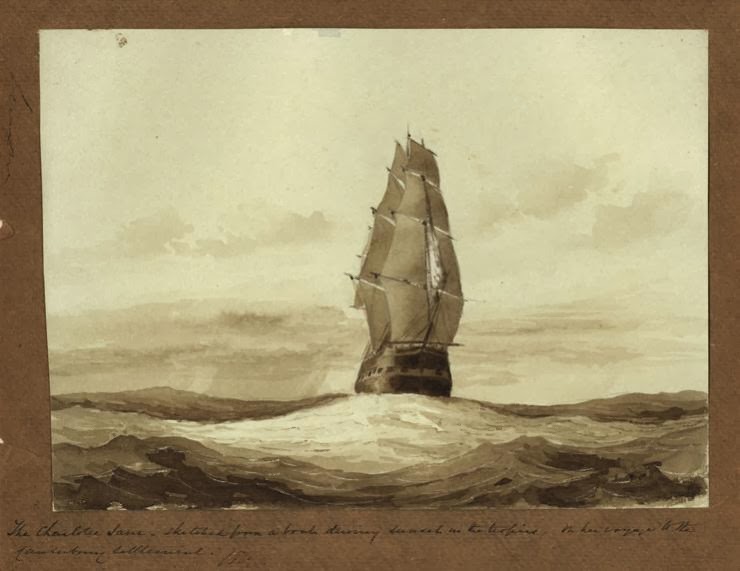
Tuesday, September 24th 1850 on the three-mast ship the Charlotte Jane in Mid-Atlantic, off Cape Verde, 17 days out from Plymouth bound to Lyttelton, New Zealand with the Canterbury Pilgrims

‘Thermometer at breakfast at 85 degrees in the cuddy.

Heard that a child had died in the night - it had been sickly before but, strange to say, that the father and mother, though aware of the extreme danger of the child, did not wake anyone or take any means to gain assistance till the morning. It is believed that, not even when it was dead, did they take the trouble of informing the doctor.

After breakfast, the funeral was performed and the body of the poor child, swathed in a Union Jack with a shot at its feet, was plunged into the sea.

At that very moment a huge school of porpoises appeared, playing just abreast of the ship opposite the port hole where the body was lowered down. This was the first appearance of these porpoises, and strange to say, as soon as the body was committed to the deep, they disappeared.

Superstitious people might have made have said that a troop of angels had appeared to bear away the soul of the child through the deep to heaven.

The air is fearfully hot, and the emigrants fear it greatly’.


THE CROSSING


I needed to know who you were,

The neglected and hidden child,

Borne to paradise with porpoises.


Nobody seemed to care.

The ship’s surgeon Dr Barker

Received 10 shillings for

Every passenger safely delivered to Lyttelton

But had to pay back 20 shillings

For every passenger who died.

Economists have a label

For this kind of arrangement –

If you write the script -

It is 'moral hazard'.


But there is a name

Crossed out in the Passenger List –

Bridget Maitland, aged 11.


It seems that she was travelling

With George and Ann Allan

And their daughter Ann Elizabeth

Aged 9.


And that George and Ann’s indifference

Betrayed the fact that she was an orphan

Tagging along as a shadow -

A sometimes servant

A sometimes playmate -

At the ragged sleeves

Of the family of a poor labourer.


But how majestic Bridget

That you should be welcomed

To the deep by heavenly creatures,

Following God’s purpose

Across Enchanted Seas

To the Land of Beulah.


[After reading: ‘The Journal of Edward Ward – Canterbury 1850-51’]

Friday, September 20, 2013

Metro Manila – the film


AS A MANILENO BALIKBAYAN ...

I can’t wait to see British Director Sean Ellis’ crime thriller set against the harsh dramatic setting of modern Manila. There are over 12 million in the MM region and twice as many in the wider conurbation - with as sharp contrasts between wealth and desperate povery as are to be found anywhere in the world.

Steve Rose writes in his review in The Guardian, Thursday 19 September 2013:

‘Tales of country innocents corrupted by the big city have been a staple of cinema since the silent era, but the theme is bracingly updated here, in the colourful squalor of modern-day Manila. British film-maker Sean Ellis, clearly energised by a change of scene, plunges us into this chaotic world at street level, piling the hardships of urban life upon a hopeful young farmer and his wife from the moment they step off the bus.

Within the week they're broke slum-dwellers, struggling to feed their young kids and sliding into the poverty trap. The tide starts to turn when husband Oscar lands a job with a security-van company, a development that slowly, stealthily leads the story out of social drama territory and into a crime-thriller realm. You could complain that the characters are a little thin (perhaps owing to the language barrier), but it's a resourceful, distinctive film that builds to a satisfying crescendo’.

I lived in Manila for 7 years from 1984 – 1991 and must have spent another 12 months there subsequently working on consulting assignments for my old employer the Asian Development Bank. I've seen young labourers carried dead from building sites after they fell from multi-storey projects that had virtually no work safety provisions, and naked and deranged young women splaying themselves at the passing traffic, with blood oozing from their ear lobes whence their ear rings had been ripped.
 
For all that, Manila is a city that at first seduces and beguiles with its glamour and sophistication and then, when you come to your senses and are about to turn your back and walk away, flashes a half-innocent, half playful smile that leaves you even more hopelessly in love.
 
I’ll dig out one of my poems for old times’ sake:
 

MONDAY CROSSROADS

 
The car door closes,

I step back alone

To dirty streets

And dark shapes.


I make my way

Warily - as

EDSA roars above

The underpass.


The poor bring water

To sidewalk homes

In plastic buckets

Yoked or dragged.


Vendors roll their mats,

Set out their goods,

Cigarettes and gum -

Trifles and trivia.


On a concrete step,

A dark-haired child

In t-shirt and shorts

Sleeps fitfully.


As dawn is rising

In the viscous grey air,

The traffic crowds

To cacophony.


Reddening clouds -

In the steel grey dawn

Skyscrapers emerge

In serrated edge.


The hotel canopy

Takes me in

Cool marble and sweet air

‘Good morning, Sir’.


Entering my room

There is disorder

Sheets and pillows

Thrown aside.


And you have gone

And with you love.

Sweet-heart stay well

As day breaks hearts.


Tuesday, September 3, 2013

Deb Gets Dirty


THAT’S MY GIRL

Further to my previous post bemoaning the social pressures that we Yummy Mummies face at the School-gate, I feel the need to again step in to defend my gender – or rather my adopted gender.

And in a superb demonstration of the Six Degrees of Separation principle, my new story has ‘everything’ - dealing as it does with New Media Freedom, Sexism, Auckland NZ, Robin Thicke, a raunchy ‘viral’ video clip and a link in the chain of my own Family History.

The ‘Law Review Girls’ of Auckland University Law School have gone down and dirty on Thicke’s “Blurred Lines”, which has received a right old hammering world-wide from the ladies.

Katie Russell from Rape Crisis has commented:

"Both the lyrics and the video seem to objectify and degrade women, using misogynistic language and imagery that many people would find not only distasteful or offensive but also really quite old fashioned.

"More disturbingly, certain lyrics are explicitly sexually violent and appear to reinforce victim-blaming rape myths, for example about women giving 'mixed signals' through their dress or behaviour, saying 'no' when they really mean 'yes' and so on."

So getting a few words [and actions] in edge ways is fair game.

One of the creators of the parody, Olivia Lubbock sets out its aims in the following terms:

"We think that women should be treated equally, and as part of that, we're trying to address the culture of objectifying women in music videos.”

The video was temporarily banned by YouTube, which of course has fired it up with a massive oxygen blast in the social media furnace, with 450,000 views in a few hours.

It shows men in their underwear with dog leashes around their necks being squirted with cream and having dollar bills stuffed into their pants, though it is keen to assert at its start that ‘No Men were Harmed in the Making of this Video’.

Speaking of the YouTube ban, Olivia has commented:  “It’s been flagged by users as inappropriate because of sexual content and stuff like that, but the fact it’s been taken down is a massive double standard.

“My opinion is that people don’t like the message behind it. It was meant to be a comedic sketch, but we’re trying to address the culture of objectifying women in music videos. We think that women should be treated equally.”

No complaints there.

And I am delighted to report that Olivia is a very remote family relative!

She is the grand-daughter of veteran and venerable social justice campaigner Eric Lubbock, Lord Avebury, a Lib-Dem Peer who sits in the UK House of Lords. I regularly follow Eric’s blog at:


And some years ago, after I became interested in Family History, Eric’s elder son Lyulph kindly sent me a family tree which contained, to my immense surprise, a reference to 'Harry Johnson marrying Constance Maud Mary Lubbock'.

So I have posted as my header a picture of ‘Our Darling Olivia’ on a less louche occasion with all her clothes on!

For more on the story and a link to the video, see:

 
For more on Lubbock Family History use the Search Engine in this Blog.

Sunday, September 1, 2013

The Brandywine Valley, Pennsylvania - Unexperienced Recollections


A LANDSCAPE OF THE MIND

There are some places that can be readily pinpointed in one’s mental atlas, even though you may never visit them. And the Brandywine Valley in Pennsylvania goes further and gets an entire page write-up in my interior gazetteer.

I began to travel its turnpikes and leafy lanes some years ago, watching the woods glimmer gold and red in the autumn sun as they stood back from the highways, catching views across the ample fields of old farms with their Dutch barns and slip-rail fences.

Let’s hope that someone in West Chester or Lancaster, Pennsylvania reads this and invites me over to experience the ‘reality’!

Picking up what Jessica Kourkounis of the New York Times wrote yesterday:

‘The physician and poet Oliver Wendell Holmes Sr. traveled through the gently rolling hills of the Brandywine Valley in southeastern Pennsylvania during the Civil War when he came there to search for his son, whom he feared had been killed in battle.

'It was a grim mission — and luckily, his son survived — but the land made a strong impression. “The grazing pastures were so green ... the houses were so comfortable, the barns so ample, the fences so well kept, that I did not wonder, when I was told that this region was called the England of Pennsylvania".

For Jessica’s more recent tourism promo article, see:


Athough I have never been to this part of the USA, I have written several articles about its early settlers, and the origins that many of them share with me in the North West of England [and rural Cheshire in particular]:


As Barry Levy’s work shows, these Lancashire, Cheshire and Welsh Quakers brought a new vision of family and social life to America--one that contrasted sharply with the harsh, formal world of the New England Puritans. The Quakers stressed affection, friendship and hospitality, the importance of women in the home, and the value of self-disciplined, non-coercive childrearing.’

They also brought with them the frugal habits of ‘North-western English middling families [those who had to work but could keep “some measure of independence by owning a small business or by securely occupying a piece of land)’ and their Quakerism led them to widen their sense of family to the community at large while it promoted their prosperity through the sharing of labour and resources.


QUIET AMID THE CONFUSION

So I read Jessica’s article with delight – and couldn’t resist doing a little more digging around on the internet – especially on the Battle of Brandywine Creek. I hadn’t quite realized that the surnames of two of the Cheshire Quaker families among the 17thCentury settlers were reflected in a couple of locations that figure in the battle. The places are ‘Darlington Corners’ and ‘Dilworthtown’.

My stepfather was a Darlington – and when we went back to Cheshire, UK for a holiday in 2005, we stayed in a vacation cottage at the Dilworth’s farm in Cholmondeley.

Apparently, as the full measure of the American defeat at Brandywine Creek unfolded, Major Generals Anthony Wayne's army fought a series of rear-guard actions against the British which eventually saw the village of Dilworthtown overrun and used as a holding area for American prisoners. See:


Finally a fierce artillery duel bought the retreating Americans enough time to move out in reasonable order:
 
‘The duel for the guns bought Wayne just enough time to form his division in a strong position behind a stone wall covering the road to Chester. The British advanced rapidly against the Pennsylvanians and were met with volley fire and grapeshot. More and more British troops crossed the ford and joined the battle line, until even the fiery Wayne had no choice but retreat. The Pennsylvania Line began a slow, orderly withdrawal, halting at every stone wall and fence line to loose off a volley or two at the King's men.

'Out of the growing darkness stumbled Armstrong's retreating division of Pennsylvania militia. A soldier of the 3rd Philadelphia Associators remembered: "Our way was over the dead and dying, and I saw many bodies crushed to pieces beneath the wagons, and we were bespattered with blood. As we marched directly under the English cannon, which kept up a continual fire, the destruction of our men was very great."

But the British broke off the action by 7 pm, allowing Washington's army to ‘stagger and stumble’ along the road to Chester throughout the night.’

Of course, the Quakers were pacifists and took no part in the battle, though, as I recount in one of my other stories, a Darlington farm [presumably located at or near Darlington Corners] was commandeered early in the battle by the British army as one of its centres of operations.

When the battle had first commenced, the first encounter between the opposing forces thad taken place at a tavern in Kennett where the British were initially repulsed. This opening battle was fought at mid-morning around the meeting house while the pacifist Quakers continued to hold their midweek service. One of the Quakers later wrote, "While there was much noise and confusion without, all was quiet and peaceful within”.

Quite what the Cheshire Quakers would have thought about contemporary airstrikes and drone warfare is an interesting conjecture. But then again, warfare had a more civilised and gentlemanly guise in those days, at least for the officer class.

Prior to the battle, both the American and British forces had had a hard time figuring out each others’ positions – given the nature of the landscape, the presence of fog and General Sir William Howe’s nimble and crafty tactics. And as I recall from earlier research, at one juncture Washington was spotted within range by a British column as he reconnoitred the lie of the land -  accompanied by his aides de camps and Lafayette.

However, the British officer deemed it bad sportsmanship to kill the enemy commander by sniping – and Washington’s party rode on oblivious to their prior peril.
 

Saturday, August 31, 2013

For Seamus Heaney


The Fine Print of Purgatory

Like Seamus Heaney, I was a farmer’s boy
Or rather I became one
When I was four and signed my lease
In hearts’ loss -
Paying my ingoings
In mud and shit and love.

I too saw kittens drown -
And pigs slaughtered
Squealing at hell’s gate,
Blood caught in an old tin bath -
And dogs shot in the drive
Slinking as the 22 rose and leveled.

There can’t be many of us
Who felt white-washed walls
In the dark, as the cows respired -
Smelled the poetry there,
Looking up the stock at night
By torch and latch and moonlight.

Those cattle died of plague
And ended in a bulldozed pit
Near the stack-yard –
And my almost father
Broke his heart for loss
While I was bush-bashing outback tracks.

Few I’m sure will know now
The turnip shredder in the picture
Or have eaten a slice cold from the handle swing.
Now and again, we used to feed turnips
To my Connemara pony Jonty
Before he was knackered by a winter’s standing.

There is cruelty then in much remembering -
But life it was in deeds that dated
With death foreshadowed in a codicil.