Popular Posts

Monday, August 5, 2013

Lost Legacies


I TOLD YOU SO

Oral family history is slippery stuff. When I was back in England recently, my cousin again mentioned a supposed legacy that had slipped out our hands when my great grandmother Sarah Kenyon [born 1862] fell victim to the machinations of an unscrupulous interloper with the name of Ormerod.

I can find nothing so far that might corroborate this story.

In the 1881 Census Sarah is recorded as a 19-year old living with her married sister Betty Nicholson in modest circumstances in Oldham. Betty was also a witness to Sarah’s marriage to my great grandfather David Clarke on 9th April 1882 – the bridegroom was 39 years old.

It seems that Sarah’s father Oliver Kenyon was a publican and small-scale ‘provisioner’ [i.e. wholesale merchant] and that both Oliver and his wife had died before Sarah reached adolescence. The Kenyons left two sons and three daughters – and little evidence of wealth – though Oliver did come from an interesting family which ran pack-horse trains across the Pennines from their farm near Middleton.

I suspect that Sarah, as an orphan and later wife of a much older and relatively successful man, had developed something of a fantasy about her origins that none could contradict as she had moved from her native Oldham in Lancashire to settle in then distant Nantwich, Cheshire. On the other hand as orphans the children may indeed have been prey to skulduggery.

In the case of my father’s family the ‘Johnsons’ almost nothing cam down to me by word of mouth, as my father had been killed before I was born and his immediate relatives had either died or dispersed to as far away as Canada by the time I became interested in our origins.

There was though one snippet, which had slipped through to my mother - surviving my grandfather’s change of name from Shorrocks to Johnson to gain anonymity and his reluctance to otherwise provide facts and links. This was that the family [or now I would add one successful member of the family] had operated a pub [and now I can clarify that it was in fact a hotel on a very grand scale].

It seems that James Henry Shorrocks, the eldest brother of my great grandfather Robert Edwin Shorrocks, became a very successful dance hall operator in Manchester - he had a ballroom for example in Chorlton-on-Medlock. Building on his success, he purchased a large country house at the end of the 19th Century in Bispham on what became Blackpool’s North Shore which he eventually converted from a private residence into the Norbreck Hydro Hotel.
 
 
In 1912, ‘Uncle Jim’ formed a public company and developed a fashionable venue and leisure complex with its interiors modelled in the manner of ocean liners like the Titanic. The building was expanded in several phases, and eventually encompassed 400 bedrooms, with a ballroom, swimming pool and solarium by the early 1930s, together with a bowling green and an adjoining 18-hole golf course.

Initially, the clientele must have consisted largely of the managerial class of the mills, mines, shops and enterprises of the towns of North West England. One can imagine that during the Wakes Weeks, in which whole towns in Lancashire shut down the cotton mills to give their workers a week’s holiday, opportunities were taken by the upper middle class to exchange business information, undertake transactions and arrange dynastic marriages. A sort of Northern version of the aristocratic plot hatching, mate-matching and gossip-dispatching that used to take place at Bath a hundred or so years earlier.

And it seems that the Hydro was later patronised by nobility and the British upper class, in addition to being a venue for the top stars of stage, screen and radio.

[And as Wikipedia reports:

‘In the late 1970s, the hotel's disco became the venue for a number of concerts by punk rock, new wave and Mod revival bands. Those who played there included the Angelic Upstarts, Penetration and the Purple Hearts. The venue also saw gigs by two bands before they became famous. Adam and the Ants performed there when they were still a punk rock band in March 1979, a performance which One Way System drummer Dave Brown, listed in his top five gigs. And on 15 March 1979, The Pretenders played one of their first ever gigs at the Norbreck.

In 1988, the hotel was the venue for a conference where the Liberal Party and Social Democratic Party merged to form the Liberal Democrats. Writing in the New Statesman about the merger, the writer Jonathan Calder said of the hotel, "Blackpool’s Norbreck Castle Hotel does not lift the spirit at the best of times, and in January 1988 its Soviet ambience was enhanced by the trams and melting snow in the streets outside."]

 WHAT GOES AROUND COME AROUND

So hearing my long-lost relatives mention ‘Uncle Jim’ at our recent reunion in Silverdale, during our July UK holiday] added to my commitment to make a sentimental journey to Blackpool and take some relief from the unerringly beautiful countryside of the Lakes, Dales and Forest of Bowland.

As a kid, I went to Blackpool year after year in the autumn when the harvest was over at the farm [my stepfather was a devotee of the Variety Shows that played at the three piers and the Winter Gardens]. And of all the places that I revisited on my trip, I think that Blackpool is the least changed in ambience, though the substitution of car parks for front gardens in the forecourts of the boarding houses and small hotels has even augmented the sense that man has paved limbo and settled for fish and chips and beer in despair of reaching heaven.

Nonetheless, we made our pilgrimage to the Norbreck Castle Hotel and sat for awhile drinking shandies and coca colas in what remains of the old sun lounge, soaking up the sense of times past and frayed grandeur. I won’t be unkind but have to remark that I would not like to be landed with the bill for totally remediation.

So I have since set about chasing Uncle Jim up again on the Net and found to my delight that, like me, he was prone to putting a bit of stick about with the local Council on the question of the Rate Burden! It seems that here the genes and memes are gyring back and overarching in a lazy double helix.


Sunday, August 4, 2013

Returning to Wroxeter - Summer 2013


LUNCH AT CRESSAGE


The wind has set aside its ire for love

And nuzzles nape of sun

The shadows drain the blush above

As ripples through the shallows run.


At Riverside the glasses bubble

Where the basking Severn weaves

And joys the Shropshire summer double

With steak and beer and cheese.


Then, it was two thousand years or so

That Marius chinked his glass

And watched the boatmen heave and row

Through willows to the quayside grass.


Here with the heat of day at peace

Specks of why meet sigh and cease -

The river of life ne’er ran so quiet and high

Then thought Mario, now again think I.


The sun, it turns and shares the kiss

So soft the courtship scarce begun -

To-day we celebrate such joy as this

With those who dream at Uricon.
 

Saturday, August 3, 2013

Fracking Eck and the Ogre from Lloegyr


BACK ON MI WOM BONK

We have just spent three delightful weeks back at my turangawaewae [Maori for ancestral hearths] in Cheshire and Lancashire. The trip also incoprorated North Wales - so it was a real pilgrimage to the almost forgotten cultural and political entity that bound together the original inhabitants of the North West, linking Cymru [Wales] with Yr Hen Ogledd [the Old North].

As a North Westerner by origin and a long-time sceptic of Heathrow Airport [which it seems is about to expand again to engulf the whole of western London], we flew into and departed from Manchester.

‘When I was a lad’ the smell of cow shit hit you as soon as the plane doors opened. Not any more – Manchester Airport is now glitzy, brassy and confusing enough to be anywhere. I could only smell aircraft fuel.

Like many of the Australians and New Zealanders with British backgrounds, I have a somewhat complex relationship with my Mother Country - all the more so in my case because I am a first generation emigrant.

But summoning consciousness through the fog of endless eons of sibilance, vibration, claustrophobia and immobility of long distance plane travel, I was still thrilled to watch the flight-path sat-nav track over the coast of NE Norfolk and then settle over Glossop and Macclesfield as we awaited our landing slot.

Catching the highly efficient light rail / tram into Piccadilly, I was stunned by the greenery. What once were blasted stretches of obsolescent industrial grime are now smiling bosky coppices. A few astute businessmen must have made an absolute fortune growing saplings for the planting programmes. And this seemed to be a region-wide phenomenon. Driving the M6 from Manchester to Carnforth we didn’t see a single mill chimney through the miles and miles of fringing trees.

The only place where this has not happened is Blackpool. Here clearly there is some kind of city by-law which prohibits anything green and growing. Lowry would be proud of the City Fathers for preserving a heritage of gravel, tarmac, brick and concrete at an inhuman scale – all that’s needed is to set some smoke billowing out of the top of the Tower.

Talking of Blackpool, I mentioned the word ‘fracking’ while getting some change for the kids in an amusement arcade and was treated to a tart lecture about earthquakes [and that to a Wellingtonian!]. It seems that the locals are not too keen on Cuadrilla’s shale gas exploration programme in the nearby countryside.

Mind you, the magnitude 2.3 earthquake on the Richter scale, that hit the Fylde Coast on 1 April 2011 followed by a second of magnitude 1.4 quake on 27 May would scarcely rate a mention in New Zealand.

But this is only a foretaste, as Cuadrilla Resources estimates that the shales beneath the Fylde may hold 5,660 billion cubic metres of gas – of which about 20 percent may be recoverable by “fracking" [involving hydraulic fracturing by pumping water, sand and chemicals at high pressure into shale rock, to release the gas it holds].

As the Maori proverb maintains: ‘Whatungarongaro te tangata toi tu whenua [As man disappears from sight, the land remains].

Not so much nowadays. It used to comfort us that, amid life’s turbulence and transitions, ‘the land alone endures’. But as we increasingly rape and trash landscapes, nature struggles to provide us with emotional sustenance - substituting solastalgia for solace. 

And it particularly saddens me to learn that an unspectacular but perfectly ordinary piece of gentle farmland in Central Lancashire is being fractured for its gas. As my own ancestors toiled for generations on farms, fishing boats and workshops in Fylde and its nearby foothills, I feel an affinity.


[Pictures above of the view looking west from Lower Shorrocks Hey Farm towards Blackpool Tower and the nearby market town of Poulton-le-Fylde]
 
So I was both amused and quietly enraged to learn that Tory Toff Lord Howell believes that the North East – sorry North West – is an expendable wasteland. Unlike Balcombe in Sussex – ‘four square on the Brighton line’ – where the managers live who operate the factories on the Crawley Trading Estate that put the holes in the ends of toothbrushes.

BOGGLED IN GOGLEDD

As Jane Merrick commented in the UK Independent on the perceptions of ‘Southern’ Tories like Baron David Howell of Guildford:

‘This is only anecdotal, but the “northern problem” seems to be a psychological one, and, admittedly, on both sides. One seems to have an atavistic distrust of the other. Northerners think the Tories are only interested in policies which benefit the south. A lot of Conservatives think the north is bandit country, that we are uncouth savages who don’t care about our countryside or cities.

‘Both perceptions are wrong, obviously.

‘Anyone who has visited Northumberland, or County Durham, or North Yorkshire can see that Lord Howell is mistaken. If by “desolate”, Lord Howell means the outstretched beauty of the North Yorkshire Moors, or the dramatic coastline of Northumberland, then give me desolation over, say, the chocolate box villages and caramel-coloured manor houses of the Cotswolds, the favourite stamping ground of Mr Cameron and his friends.

‘Give me a place where I can walk to the next village without encountering another car, where I can buy a pint for less than £2, where the Hunter wellies are encrusted with mud, not gravel from huge drives, and where the peace is never spoilt by a helicopter ferrying Jeremy Clarkson to his new mansion.

‘The north-east – and, while we’re at it, the north-west, which firms like Cuadrilla believe to be an easy target for fracking – shows England in its unspoilt, geologically undressed state. I wonder where Lord Howell was thinking of when he referred to “beautiful rural areas”, if not the north? Because, with the greatest respect to the people of Guildford, whose town is associated with Lord Howell, and its surrounding countryside of Surrey, I want mountains and lakes, not a series of golf courses and gated homes.’

See:

And I find that my own comments are just a speck in a swelling ocean of backlash.
 
Try David Banks in the Journal, for example:

‘.... I offer the following Thought for the Day. . .

‘Resting on the seventh day, after his wondrous act of creation, God explained proudly to the Archangel Michael how his greatest work had created planet Earth, a world in perfect balance.

“For example,” he explained to the puzzled Archangel, “there is North America, a place of great opportunity and wealth, while South America is going to be poor.

“The Middle East will be a hot, arid spot while Russia will be cold and covered in ice.”

‘Michael, impressed by God's work, then pointed to another area. ”What's that?”

“Ah,” said God. ”That's the North of England, the most glorious place on Earth: beautiful people, seven Premiership football teams, impressive cities and the home of the world's finest artists, musicians, writers, thinkers, explorers and politicians.

“People from the North of England are going to be modest, intelligent and humorous and they're going to be found travelling the world.

“They’ll be extremely sociable, hard-working and high-achieving, and they will be known throughout the world as speakers of truth.”

 ‘Michael gasped in wonder and admiration, but then proclaimed:  “What about  balance God, you said there would be balance?”

 ‘God replied very wisely: “Wait till you see the bunch of tossers I'm putting down South to govern the country!”


I added a comment to Jane’s piece which runs:

‘As an expatriate from the North West who has recently holidayed in rural Cheshire, North Wales, the Lake District and the Forest of Bowland, with my Kiwi wife, I have been struck by her wide-eyed enjoyment of the scenery and response to the warmth and hospitality of the locals [overweight though many of them may be].

‘This is in contrast to our previous visit, when I took her on a biscuit tin lid tour of the picturesque South. Adrift in thatch and cob villages, she was constantly apprehensive about being jostled into becoming the Maid of Midsomer at a Fair and being killed in a case of mistaken identity by a cross-bow wielding Morris Dancer.

‘Once Australians and New Zealanders get over the fact that Laura Ashley also designed villages [with every nook nick-nacked, as applies also to interiors], they much prefer the North where they can spot a rogue Morris Dancer far enough away to bring him down with a mere or a boomerang.’

All good fun – but tinged with a bitterness that bodes ill for the survival of the UK as a cohesive political entity.

Several of the other commentators on Jane Merrick’s article suggested that it might be time for Northerners to consider joining Scotland in a quest for Independence – in essence the isolation of ‘Lloegyr’ [England south and east] from the rest of the British Isles. 

A political regrouping, with a federation between Cymru, Yr Hen Ogledd and Albion would constitute an economy with a GVA of £412 billion per year [around a third of the GDP of the island of Great Britain].  It would rank around 20th in the international GDP stakes somewhere between Switzerland, Saudi Arabia and Sweden.

And as for an impending Civil War to preserve the Union, a Northern prophet has already foretold the fall of the Old South as Guildford and Richmond-on-Thames succumb to barrages of black puddings and Lancashire bomb cheeses.

For more, read ‘Come Back With the Wind’ by Les Dawson, in which the threat of an embargo on whiskey sales to the South confirms secession. A timeless tale of ‘love, honour and alcohol’ in which ‘battle lines will be drawn, friendships and family ties tested and kegs tapped as the path to war approaches, albeit with a hiccough or two’.

RELATED ARTICLES ON THIS BLOG [for example]


Tuesday, July 30, 2013

Revisting Beeston Castle from New Zealand - Summer 2013


ALL GOOD
 
Eons of flight-path inching set aside,
Back to earth that bush and nettles hide,
Bounding up the hill, we who came so far
Unfold the plain to glimpse towards the farm
And seek the tree where nanna’s ash was laid.
 
Below stand Beeston Castle’s broken walls,
With tat and ice creams in the shop beneath
As jest and jostling dust away the galls
And rollicking up, there’s young mischief.
 
Fifty summers now the scene divide
As sunlight basks away the evening star -
With balls to throw and kick, and picnic plied -
We set to side the bales that maul and mar.
 
Hawthorn, oaks and sward tops standing wide -
Seasons come, the scythes of harvest bide.


Friday, July 19, 2013

Clan Shorrocks Reunited after 100 years!


ALL FORGIVEN - NO LONGER FORGOTTEN
At some point around 1905, my grandfather Harry Shorrocks [who was then about 25 years old] decided to mooch away and start a new life. He left his family in Salford, Lancashire and did a runner to London, where he reinvented himself as Harry Johnson.
After he married my grandmother Connie, Harry remained mute on the subject of his origins.
But he reckoned without the 21st century potential for online research on UK Census records, male-line YDNA testing, and the contacts that can now be established through the Social Media.   
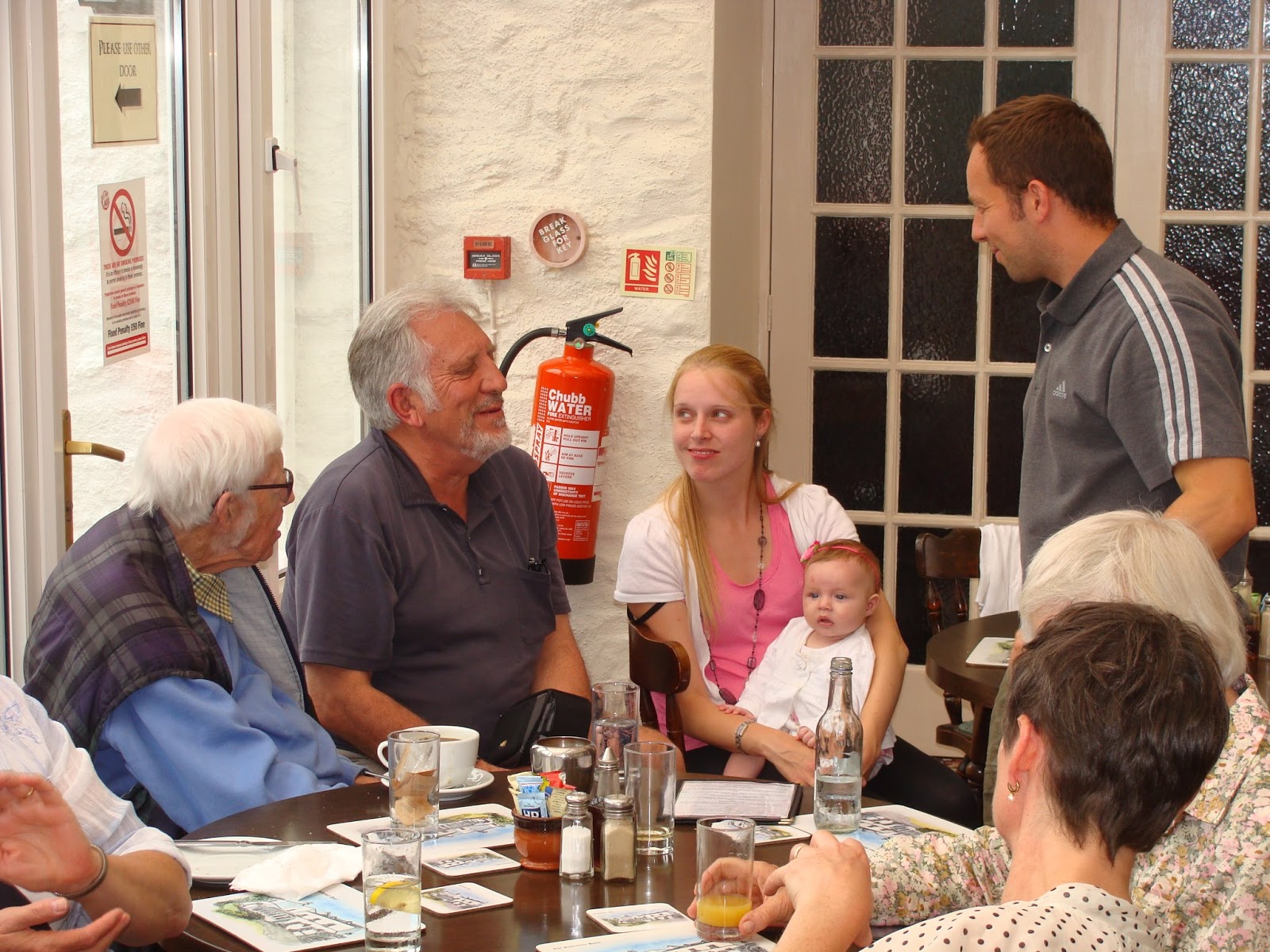
On Monday, a genealogical ‘brickwall’ was finally cleared away as my immediate family was treated to a fine pub lunch in Silverdale, Cumbria by the descendants of Harry’s brother Robert. Wonderful people and a warm and touching occasion – with immediate rapport between the two wings of the reunited family.
As for Harry’s decision, it seems that morality and propriety were at issue. When I mentioned that Harry had been known as a man who liked drink, women and gambling, his nephew 87 year-old Eric Shorrocks  - my father’s cousin, who remembers Harry being talked of in hushed tones - just sighed.
Case closed!
 

Thursday, June 20, 2013

Keith Johnson's Australasian Bestiary - the Ruru or Morepork


The Wisdom in the Rending Wind


The storm is shifting rafters, lifting eves.

It’s dangerous to walk against the wind

And black rains lash and sting the hillsides blind

As now, so then hau puhi howls and heaves.

 
Those born of rutting sky and earth have sinned

And sorrows blow against the cliffs and trees.

The children rend the darkness, seize the light

And grief and yearning strain the breaking seas.

 
Now owlish eyes can turn from side to side

And guard as spirits stray and wander wide.

 
Dark and emptiness flee before the sight

Of warmth and wisdom as the gale retreats -

And you my friend will croon ruru tonight

When the waking Bush its dusky lover greets.


FOR THE SOURCE OF THE PAINTING SEE:

Friday, June 7, 2013

Poneke Slammers skin Jo'ville Jackals!

 
THREE TRIES DOWN, THEY COME BACK TO WIN BY TWO POINTS IN A 70 POINT GAME!